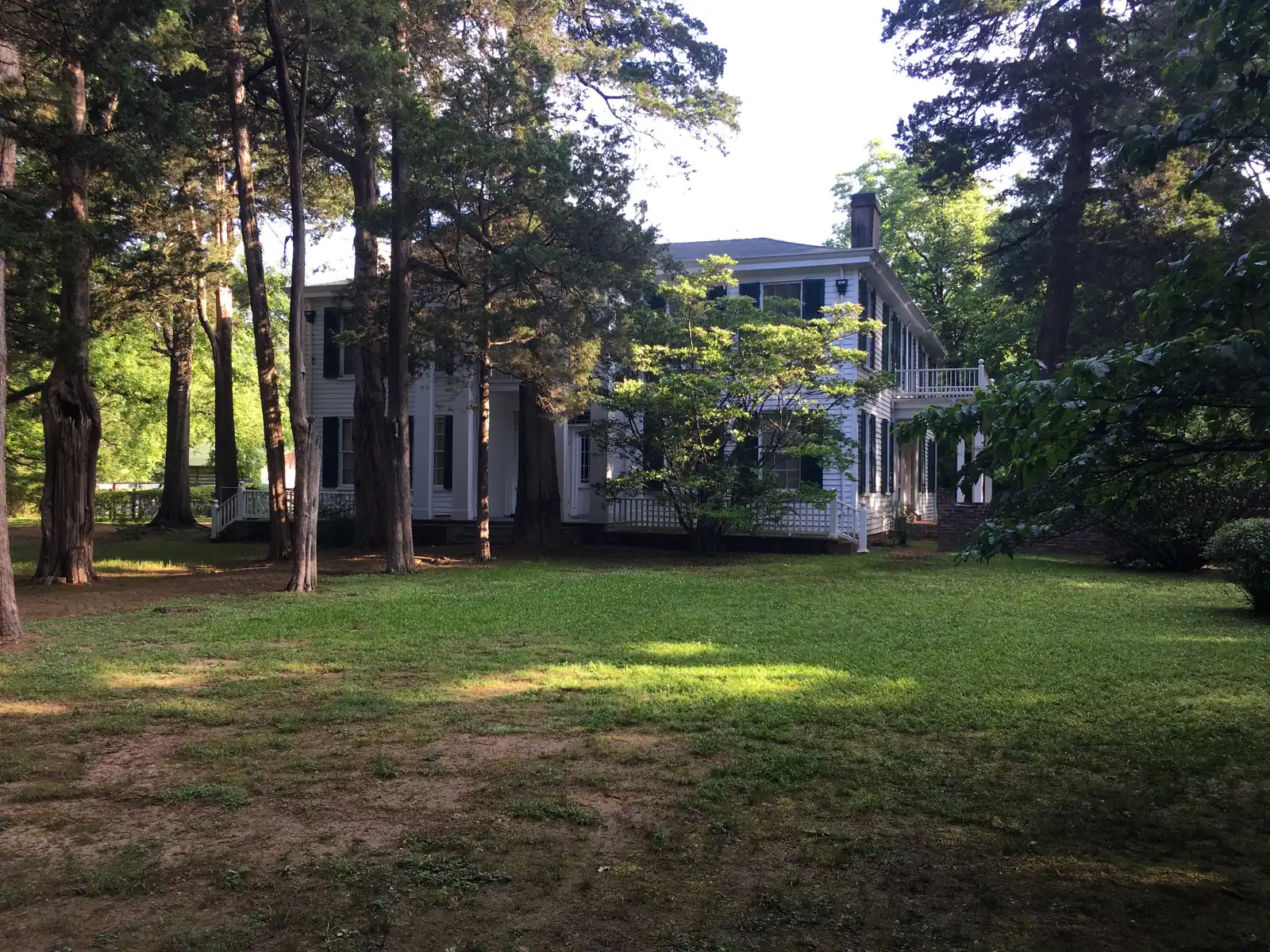
Oxford was founded on 50 donated acres in 1836 and chartered a year later. Its 14 National Register listings include Rowan Oak and the Courthouse Square.
Last checked Oct. 12, 2026. History comes from the City of Oxford’s history page; National Register listings and dates are from the National Park Service’s National Register data (file of May 22, 2026). Visit Oxford: 662-232-2477.
Oxford was planned around a university before it had one. In 1836, three residents of the newly created Lafayette County donated 50 acres for a town and named it after the university town of Oxford, England. Oxford received its charter almost a year later, and in 1841 it won the Legislature’s vote to become home to Mississippi’s first state university, which opened in 1848.
Visit
- Rowan Oak (William Faulkner’s home): Old Taylor Road; open for tours Tuesday through Sunday
- University of Mississippi Museum: 412 University Ave.
- L.Q.C. Lamar House Museum: 616 N. 14th St.
- Visit Oxford (tourism office): 662-232-2477, visitoxfordms.com
How Oxford began
Before 1836, Chickasaw people lived on the land that is now Oxford. The Chickasaw Cession of 1836 opened North Mississippi to settlers, most of them from the Carolinas and Virginia, the city’s history page says. Lafayette County, named for the Marquis de Lafayette, was created that year. John Chisholm, John D. Martin and John L. Craig donated the land for the town; it had been owned by a Chickasaw woman known as Princess Hoka, the namesake of the old Hoka Theatre.
Key dates
| Year | What happened |
|---|---|
| 1836 | Chickasaw Cession; Lafayette County created; 50 acres donated for Oxford |
| 1837 | Oxford receives its charter, almost a year after the land donation |
| 1841 | Legislature picks Oxford for the state university |
| 1848 | University of Mississippi opens with 80 students |
| 1861-65 | Almost 2,000 men leave to fight; the Square and the courthouse are destroyed in the Civil War |
| 1878 | Yellow fever outbreak |
| 1902 | William Faulkner’s family moves to Oxford |
| 2018 | City annexation adds almost 50 miles of roads |
Dates are from the city’s history page, except the annexation, from its Engineering division.
National Register of Historic Places
The National Park Service lists these properties and districts with an Oxford address on the National Register. Four are also National Historic Landmarks.
| Property | Address | Listed |
|---|---|---|
| William Faulkner House (Rowan Oak) (NHL) | Old Taylor Road | 1968 |
| Ammadelle (NHL) | 637 N. Lamar Blvd. | 1974 |
| L.Q.C. Lamar House (NHL) | 616 N. 14th St. | 1975 |
| St. Peter’s Episcopal Church | 113 S. Ninth St. | 1975 |
| Lafayette County Courthouse | Courthouse Square | 1977 |
| Barnard Observatory | University of Mississippi campus | 1978 |
| Isom Place | 1003 Jefferson Ave. | 1980 |
| Oxford Courthouse Square Historic District | South Lamar Boulevard, Jackson and Van Buren avenues | 1980 |
| Hopewell Presbyterian Church | 2070 Highway 10 | 1999 |
| North Lamar Historic District | Roughly North 11th, Price, North 16th and Van Buren | 2007 |
| George Wright Young House | 100 County Road 233 | 2007 |
| Lyceum-The Circle Historic District (NHL) | University Circle, University of Mississippi | 2008 |
| South Lamar Historic District | South Lamar Boulevard and University Avenue | 2009 |
| Avent Acres Neighborhood Historic District | Around Lamar Avenue, Douglas Drive and Sisk Avenue | 2020 |
Elsewhere in Lafayette County, College Church in College Hill (1979), Sand Spring Presbyterian Church near Water Valley (1993) and the Abbeville Colored School (2021) are also listed.
The historic Square
The Courthouse Square is the heart of town. The Square and the Lafayette County Courthouse at its center were destroyed during the Civil War, the city says, and the town recovered by the 1890s. The square became a National Register historic district in 1980. Changes to buildings there go before the city’s Courthouse Square Preservation Commission; the South Lamar, North Lamar, Depot and Jefferson Madison districts have their own Historic Preservation Commission.
Museums and historic homes
- Rowan Oak, William Faulkner’s home from 1930 until his death in 1962, was built in 1844 and is owned by the University of Mississippi, Visit Oxford says; it is open for tours Tuesday through Sunday. The Bailey Woods Trail links it to the University Museum but is temporarily closed for bridge repairs.
- University of Mississippi Museum, 412 University Ave., founded in 1939 as the Mary Buie Museum, holds Southern folk art, Greek and Roman antiquities and 19th-century scientific instruments.
- L.Q.C. Lamar House Museum, 616 N. 14th St., built in 1869-70 and restored in 2008, tells the story of the 19th-century statesman, according to the museum.
Check each site for current hours before you go.
What this means for you
- Start at the Square, then walk to Rowan Oak.
- Planning a renovation in a historic district? See building permits and zoning.
- More to do: things to do this month.
Frequently asked questions
When was Oxford, Mississippi, founded?
In 1836, when three residents of the new Lafayette County, John Chisholm, John D. Martin and John L. Craig, donated 50 acres for a town named after Oxford, England. Oxford received its charter almost a year later, the city says.
Why is Oxford, Mississippi, named Oxford?
The founders named it after the university town of Oxford, England, hoping to become the home of Mississippi’s state university. The Legislature chose Oxford in 1841, and the University of Mississippi opened in 1848.
Can you visit William Faulkner’s house in Oxford?
Yes. Rowan Oak, on Old Taylor Road, is owned by the University of Mississippi and open for tours Tuesday through Sunday, according to Visit Oxford. It is a National Historic Landmark.
How many National Register of Historic Places listings are in Oxford, Mississippi?
Fourteen properties and districts with an Oxford address are listed, according to the National Park Service, from William Faulkner’s house in 1968 to the Avent Acres Neighborhood Historic District in 2020.
Have your say