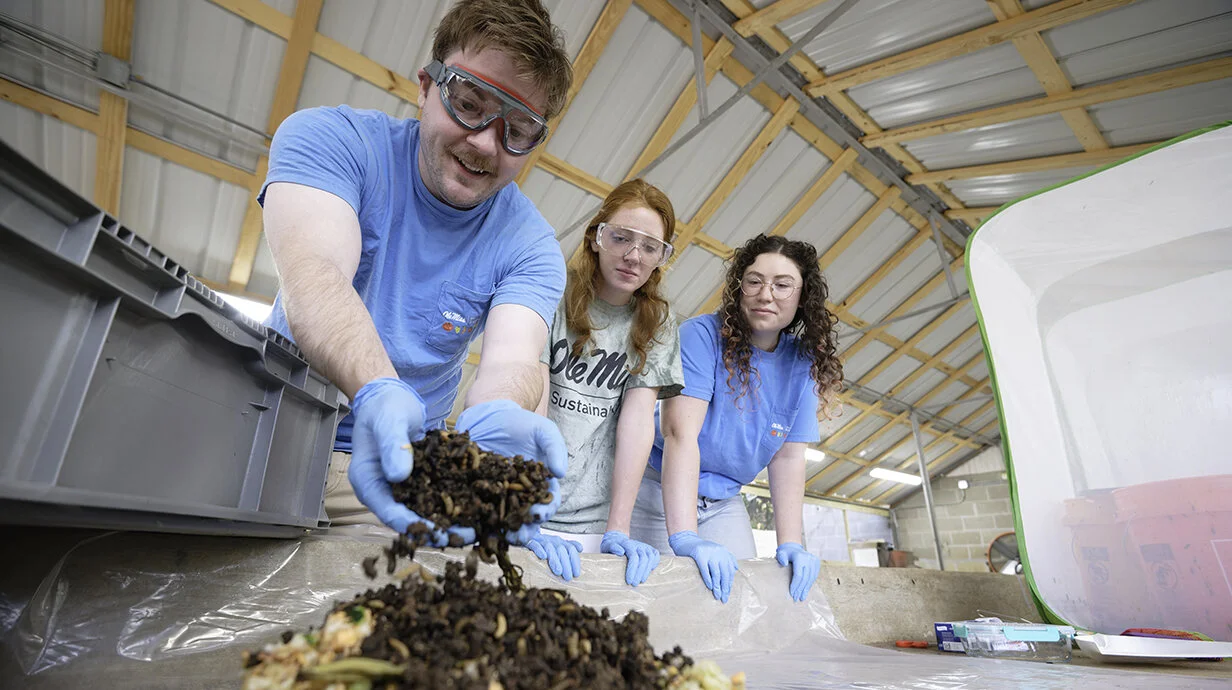
Ole Miss has opened Mississippi's first black soldier fly composting facility in a campus greenhouse. The flies turn dining waste into fertilizer, aiming for a ton a month.
Leftover food from Ole Miss dining spots is now going to flies instead of the landfill.
The University of Mississippi’s Office of Sustainability has opened what the university calls the state’s first black soldier fly composting facility. The flies eat campus food waste and turn it into a fertilizer for soil. The university announced the project in a news release Wednesday.
The university built it with dining contractor Aramark and the Mississippi Department of Environmental Quality.
How it works
The facility is in the Department of Biology greenhouse on Vaught Lane on the Oxford campus. The office converted the greenhouse with $50,000 from Aramark, the release said.
Food waste comes from Rebel Market and other campus eateries. Black soldier flies are native to Mississippi, and they eat almost anything people throw away, according to John Brugge, director of the Office of Sustainability.
“They are detritivores, which means that they eat just about everything,” Brugge said in the release. “So, the concept is simple: turn food waste into bugs, and the bugs create usable materials.”
What the flies leave behind is called frass, a mix of insect waste and shed skins that can make soil more fertile, according to the U.S. Department of Agriculture’s research service. The flies themselves can also be used in feed for chickens, turkeys and catfish.
How much waste
Students bred the flies over the summer and recently fed them their first 50 pounds of food, the release said. The targets, as the fly population grows:
- To start: one ton of food waste a month
- Long term: up to 10 tons a month
Ole Miss Dining runs 24 locations and a food truck program and serves about 12,000 to 14,000 meals a day, according to Chip Burr, Aramark’s resident district manager for Ole Miss Dining.
“Instead of heading to a landfill, it is turned into compost, which helps close the loop in our food lifecycle,” Burr said.
A test case for state rules
Mississippi’s composting rules are similar to its landfill rules, which makes new composting programs hard to start, the release said. The state is revising those rules.
Jennifer Wells, the state recycling coordinator at MDEQ, said the department has approved composting sites around the state under a pilot program. But a fly-based facility “is not something we have encountered before,” she said.
MDEQ is treating the Ole Miss operation as “a research project of sorts,” Wells said. The department wants to make sure such sites do not cause odors, noise or polluted stormwater runoff. The university said the work could help other Mississippi universities set up their own.
Until the state sets rules for this kind of compost, the frass will stay on campus, Brugge said. It will go to flower gardens and ecology projects.
What it means for you
- Less trash from campus: at the one-ton goal, about 12 tons of campus food waste a year would stay out of the landfill.
- No compost for sale yet: the frass is for campus use only until Mississippi writes rules for fly composting.
- Students run it: sustainability students have bred the flies and staffed the work, with volunteer events along the way, the release said.
Have your say